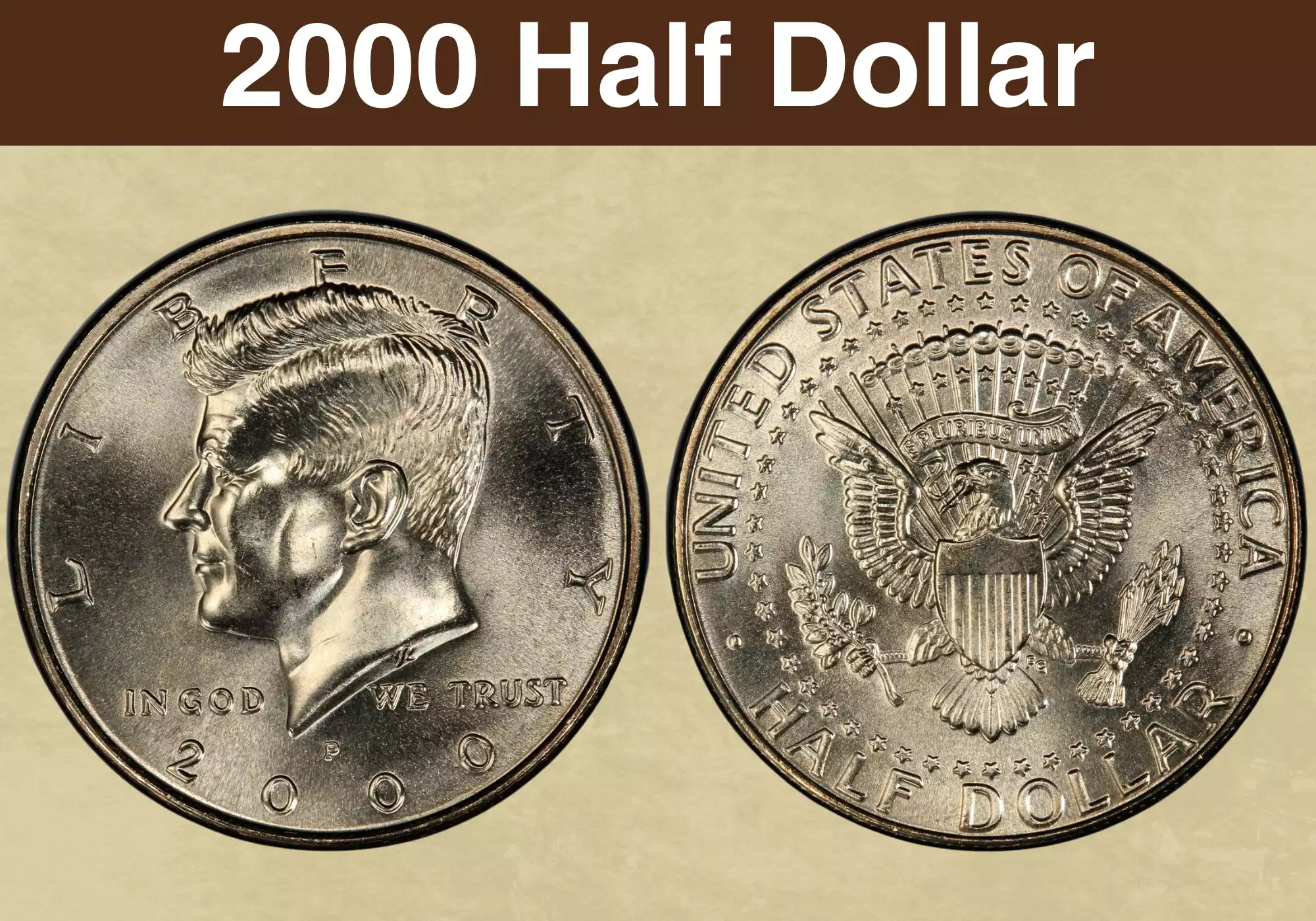
The 2000 Half Dollar Value Guide
A 2000-S Silver Proof in perfect PR70 DCAM sold for $1,840 at auction — while a typical circulated 2000-P or 2000-D is worth just face value. The gap between those two outcomes is everything: mint mark, condition, and a handful of documented errors separate a 50-cent coin from a serious collectible. This guide covers all four varieties and the five error types you need to know.
★★★★★ Trusted by 1,247 collectors · Based on PCGS auction data · 2026 edition
Check My 2000 Half Dollar Value →Free 2000 Half Dollar Value Calculator
Select your mint mark, condition, and any errors to get an instant value estimate based on current market data.
If you're not yet sure about mint marks or condition, there's a 2000 Kennedy Half Dollar Coin Value Checker tool that lets you upload coin photos for an AI-assisted assessment before you use the calculator above.
Describe Your 2000 Half Dollar for a Detailed Assessment
Describe what you see on your coin in plain language — our analyzer will highlight key factors affecting value.
Mention these things if you can
- Mint mark location (P, D, or S)
- Surface: shiny, dull, or spotted?
- Any doubling on LIBERTY or date
- Dark or discolored patches
- Missing edge sections (clips)
- Mirror-like fields with frosted portrait
Also helpful
- Weight if you have a scale (11.30g or 12.50g?)
- Any rotation when flipped
- Bag marks or contact lines
- Toning color and coverage
- Original holder or loose?
Skipped the calculator?
Get an instant value estimate — just pick your mint mark and condition. It takes 30 seconds.
Is Your 2000-D a Condition Rarity? (MS67 Self-Checker)
The 2000-D Kennedy half dollar tops out at MS67 — fewer than 100 PCGS-certified examples exist at that grade with none finer. Check whether your coin has the hallmarks of this conditional rarity.
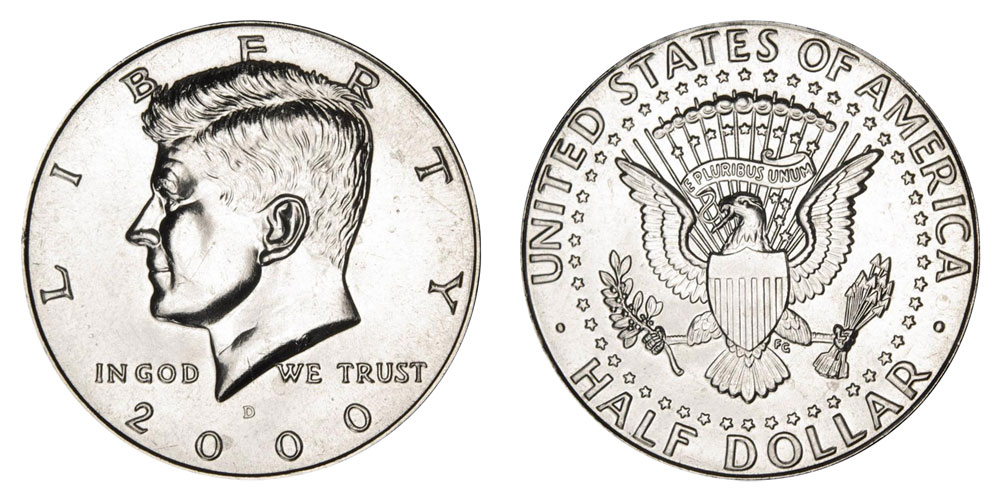
🔘 Common Example
Moderate bag marks or scuffs visible to naked eye. Luster may be dull, hazy, or partly worn through. High points on Kennedy's cheekbone and hair show slight flatness. Worth $1–$9 in this condition.
🏆 MS67 Condition Rarity
Blazing original satiny mint luster with virtually no contact marks visible. Kennedy's hair strands are fully defined. Rim is sharp and complete. Under a loupe, surfaces show at most one or two trivial nicks in non-focal areas. Worth $400–$960+ at this grade level.
Does your 2000-D show all four of these?
2000 Half Dollar Value Chart at a Glance
The table below covers all four varieties across four condition tiers. For a comprehensive step-by-step in-depth 2000 Kennedy half dollar identification walkthrough, visit the linked guide for photo comparisons and grading notes. Highlighted rows: gold = condition rarity 2000-D orange = rarest (Silver Proof).
| Variety | Worn / Circulated | Uncirculated (MS60–65) | Gem (MS66–67 / PR65–67) | Superb / PR70 |
|---|---|---|---|---|
| 2000-P (Philadelphia) | $0.50 – $1 | $4 – $15 | $18 – $55 | $430+ |
| 2000-D ★ (Denver — Condition Rarity) | $0.50 – $1 | $4 – $15 | $30 – $960 | $960+ (MS67 ceiling) |
| 2000-S Clad Proof | — | — | $6 – $42 | $42 – $1,265 |
| 2000-S Silver Proof ★★ | — | — | $20 – $62 | $62 – $1,840 |
📱 CoinHix gives you an instant on-the-go value estimate for any Kennedy half dollar — just photograph your coin and the app cross-references current market data to verify your estimate — a coin identifier and value app.
Jump to Any Section
Everything on this page about the 2000 Kennedy half dollar:
The Valuable 2000 Kennedy Half Dollar Errors (Complete Guide)
Despite tens of millions of coins struck, the 2000 Kennedy half dollar series produced a documented set of minting errors that command real collector premiums. The five varieties below represent the most frequently encountered and highest-value error types, ranging from minor striking anomalies to major die and planchet failures. Each is identifiable with a 10× loupe and basic knowledge of what to look for.
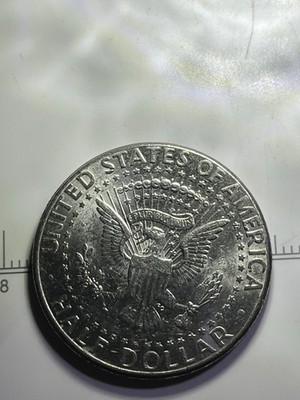
Off-Center Strike Error
MOST FAMOUS $25 – $300+An off-center strike occurs when the coin blank (planchet) is not properly centered between the obverse and reverse dies at the moment of striking. The resulting coin shows the design shifted toward one side, with a corresponding crescent of blank, unstruck metal visible on the opposite edge. This manufacturing failure happens when a planchet feeds improperly through the press or when a collar fails to fully seat.
Collectors identify off-center strikes by the incomplete design and the characteristic "shelf" of unstruck metal around part of the rim. On the 2000 Kennedy half dollar, look for missing or partial lettering in UNITED STATES OF AMERICA or an incomplete portrait of Kennedy on the obverse. The more dramatic the shift — measured as a percentage of the coin's diameter — the higher the premium. A 10% off-center is modest; 50% and above with the date still visible is where serious collector demand kicks in.
The highest premiums go to dramatic strikes (40–60% off-center) that still show the full date "2000." Pieces where the date disappears into the blank area are less desirable because attribution becomes difficult. Minor off-centers under 10% are relatively common and affordable, while major examples in Mint State condition attract dedicated error specialists willing to pay strong premiums at auction.
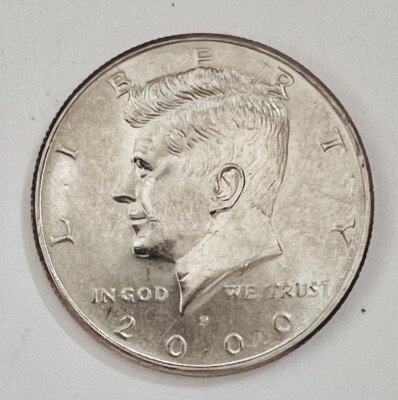
Doubled Die Obverse / Reverse (DDO / DDR)
MOST VALUABLE $50 – $500+Doubled die errors arise during the die production process rather than at the coin press. When the working die receives multiple impressions from the hub at slightly different angles or positions, design elements on the finished die show secondary overlapping images. Every coin struck from that die carries the doubling, making DDO and DDR varieties potentially more common than other error types — but high-grade examples with dramatic doubling remain genuinely desirable and valuable.
On the 2000 Kennedy half dollar, examine the obverse inscriptions LIBERTY and IN GOD WE TRUST under a 10× loupe, looking for separated letter serifs or a "shadow" image shifted to one side. The date "2000" should also be inspected carefully. On DDR examples, check the reverse eagle's tail feathers and the inscriptions UNITED STATES OF AMERICA and E PLURIBUS UNUM. True doubled die doubling shows clear separation between primary and secondary images, unlike the machine doubling (MD) that produces a shelf-like, flat echo with no rounded secondary image.
Strong, clearly visible doubling across multiple inscriptions commands the highest premiums, particularly in Mint State grades where the doubling is undisturbed by wear. Most 2000 Kennedy DDO/DDR varieties remain affordable in circulated grades, but a well-attributed example in MS65 or above with dramatic doubling can reach several hundred dollars from error specialists and variety collectors who track CONECA-listed die varieties.
Clipped Planchet Error
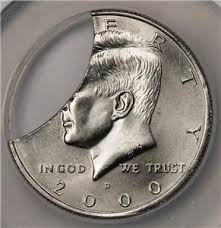
BEST KEPT SECRET $30 – $200+Clipped planchet errors occur during the blank preparation stage, before a planchet ever reaches the coining press. When the metal strip feeding the blanking press overlaps with a previously punched-out hole, the resulting blank has a curved (or sometimes straight) section missing from its perimeter. The coin struck from this misshapen blank retains the clip as a permanent feature of its geometry.
Curved clips — the most common type — produce a smooth, rounded missing section where the coin's edge should be. Straight clips occur when the strip is cut at the very end of a roll. Multiple clips on a single coin (double or triple clip errors) are especially prized. A 2000-P Kennedy half dollar with a double curved clip error graded MS64 by NGC is documented, with PCGS population data showing 25 examples certified across various grades in the clipped-planchet category — modest but genuine scarcity. The Blakesley Effect (a weakly struck area directly opposite the clip) serves as a key diagnostic to confirm authenticity.
Clip size significantly drives value: a 5% clip along the rim is common and brings a modest premium, while clips affecting 25% or more of the coin's diameter are legitimately rare and attract strong collector interest. Clean examples with fully defined design elements despite the missing section achieve the highest prices, since the visual drama of the error is maximized when the remaining coin appears otherwise gem quality.
Improperly Annealed Planchet Error
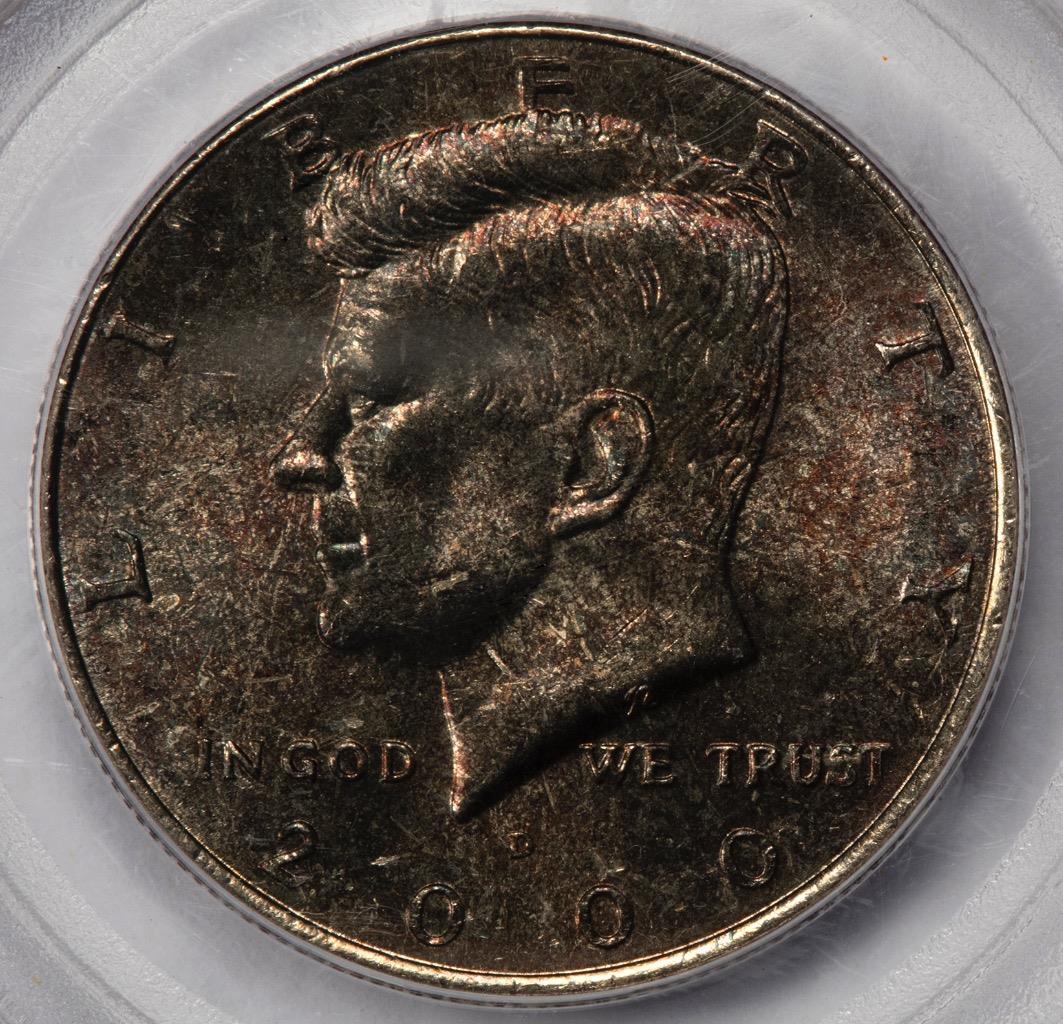
RAREST $75 – $400+Annealing is the controlled heat-treating process that softens coin blanks before they pass through the coining press, ensuring the metal flows properly into die cavities for a sharp, complete strike. When a planchet is improperly annealed — exposed to incorrect temperatures, oxidizing atmosphere, or contaminated furnace conditions — its surface develops abnormal dark brown to black discoloration. Collectors call these "black beauties," and they stand out dramatically from the normal satiny copper-nickel appearance of a 2000 Kennedy half dollar.
This error type has been specifically documented on the 2000-D Kennedy half dollar. The discoloration is typically uneven and mottled, appearing across portions of both the obverse and reverse rather than as uniform toning. Unlike post-mint environmental damage (which shows spotty, localized darkening with no underlying luster), a genuine improperly annealed planchet shows the discoloration integrated into the coin's surface before striking — sometimes with ghost-like mint luster visible beneath the dark layer where the die pressure partially displaced the surface.
A 2000-D Kennedy half dollar with an improperly annealed (sintered) planchet graded PCGS MS64 was offered at Heritage Auctions in April 2020. The significance of this date extends beyond the coin itself: the U.S. Mint implemented tighter quality controls around 2002, dramatically reducing the number of major planchet errors that escaped into circulation. This makes 2000 one of the final years when improperly annealed Kennedy half dollars reached collectors in meaningful numbers, adding historical significance to a coin that already carries visual drama.
Rotated Die Error
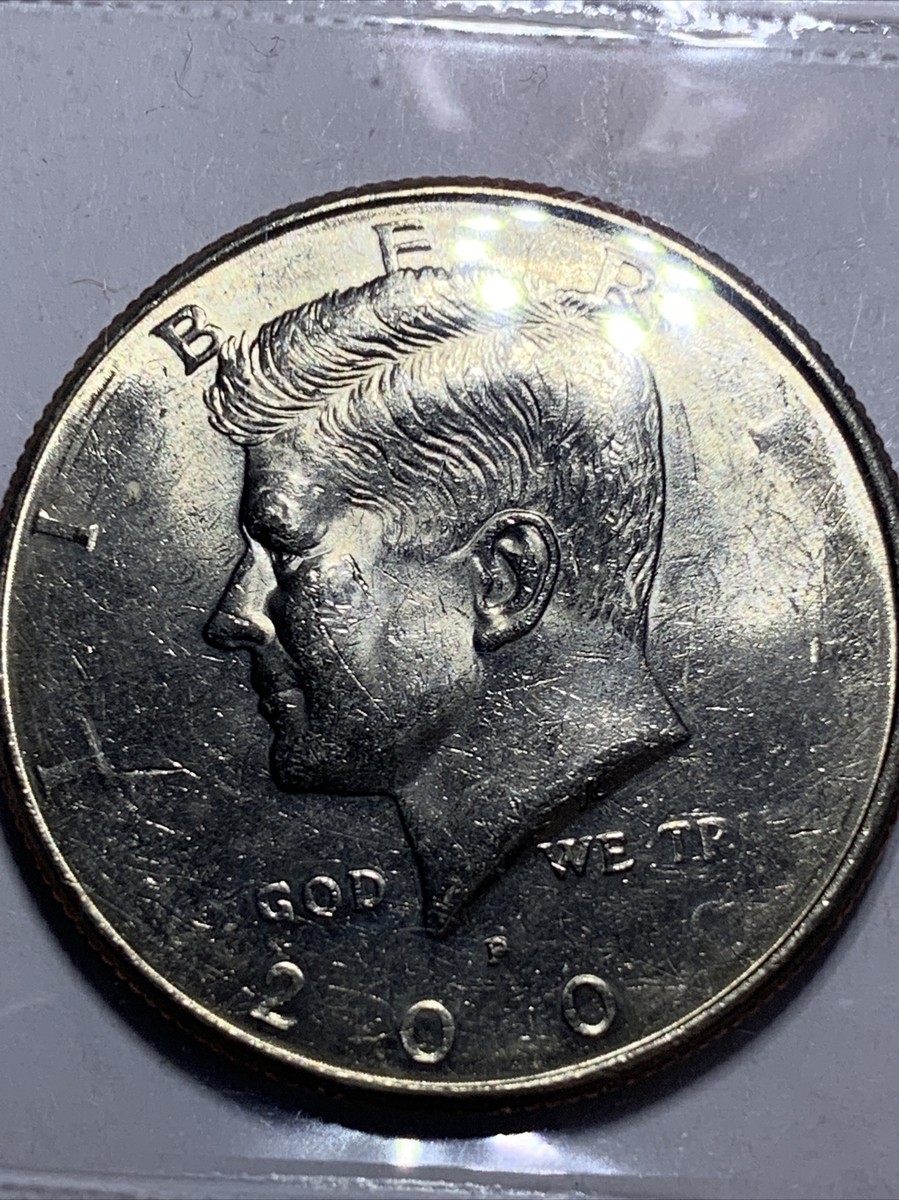
UNDERRATED $40 – $350+A rotated die error results from a mechanical installation mistake at the coining press: one of the dies — usually the reverse — is seated at an incorrect angular position relative to the other. On a properly struck U.S. coin, the reverse design appears right-side-up when you flip the coin vertically along its vertical axis (called "coin turn" orientation). Any significant deviation from this standard — even a small fraction of a turn — is classified as a rotated die error, with value increasing proportionally to the degree of rotation.
To check your 2000 Kennedy half dollar for this error, hold the coin with Kennedy's portrait upright and flip it toward you along the horizontal axis — the eagle on the reverse should appear right-side-up. If instead the eagle appears tilted, sideways, or upside-down, you may have a rotated die error. Mild rotations of 15–30 degrees are less desirable but still collectible; rotations approaching 90 degrees (quarter-turn) through 180 degrees (full medal turn) are the most dramatic and valuable examples. A 2000-P Kennedy half dollar with a 75-degree clockwise rotated die error has been documented in PCGS records, graded MS61, with a population of just one specimen known.
The scarcity of dramatic rotations makes this the most underrated error type in the 2000 Kennedy series. While off-center strikes and doubled dies receive more attention, a coin with a 90- to 180-degree rotation is a genuine die-installation error requiring a specific miss at the Mint — and the documented singleton status of the PCGS MS61 example with a 75-degree rotation underscores just how rarely these pieces are certified. Collectors who specialize in mechanical error coins actively seek rotations above 45 degrees in any Mint State grade.
Found one of these errors on your coin?
Run it through the calculator — select the error type and your coin's condition to get a value estimate right now.
2000 Kennedy Half Dollar Mintage & Survival Data
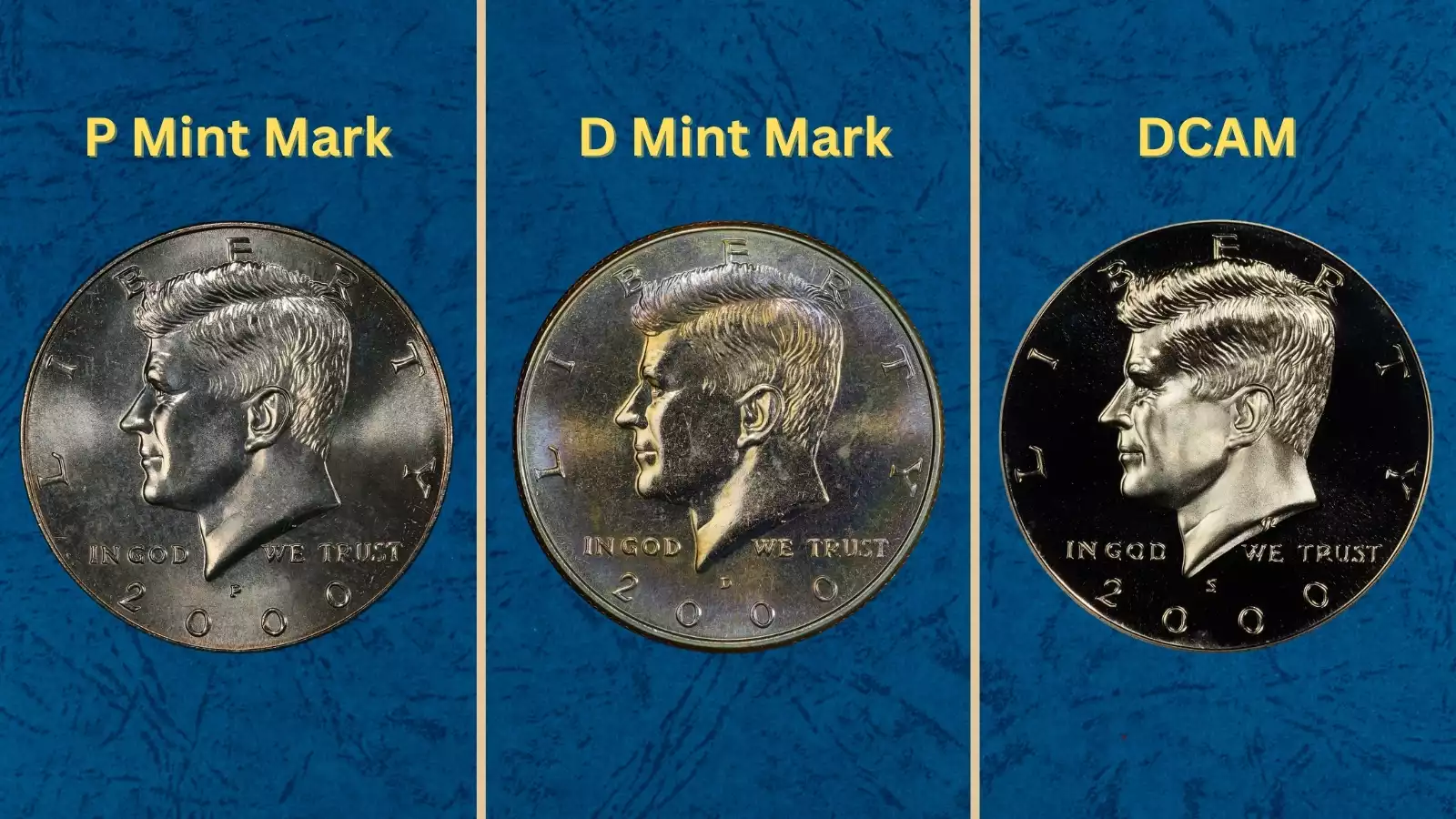
All four 2000 Kennedy half dollar varieties were produced at U.S. Mint facilities in Philadelphia, Denver, and San Francisco. Business strikes from Philadelphia and Denver entered general circulation; San Francisco proofs were sold exclusively in collector sets.
| Variety | Mint | Mintage | Strike Type | Composition |
|---|---|---|---|---|
| 2000-P | Philadelphia | 22,600,000 | Business Strike | Copper-nickel clad |
| 2000-D | Denver | 19,466,000 | Business Strike | Copper-nickel clad |
| 2000-S Clad Proof | San Francisco | 3,082,483 | Proof | Copper-nickel clad |
| 2000-S Silver Proof | San Francisco | 965,421 | Silver Proof | 90% silver / 10% copper |
| Total | 46,113,904 | All varieties combined | ||
Survival note: PCGS estimates that roughly 15.5 million of the 19.47 million 2000-D coins survive in all grades, with approximately 1.55 million in Mint State (MS60 or better) and 467,000 in MS65 or better. The extreme condition rarity at MS67 (fewer than 100 certified) stands in sharp contrast to the millions of lower-grade survivors — this is what makes the 2000-D so compelling for registry-set collectors.
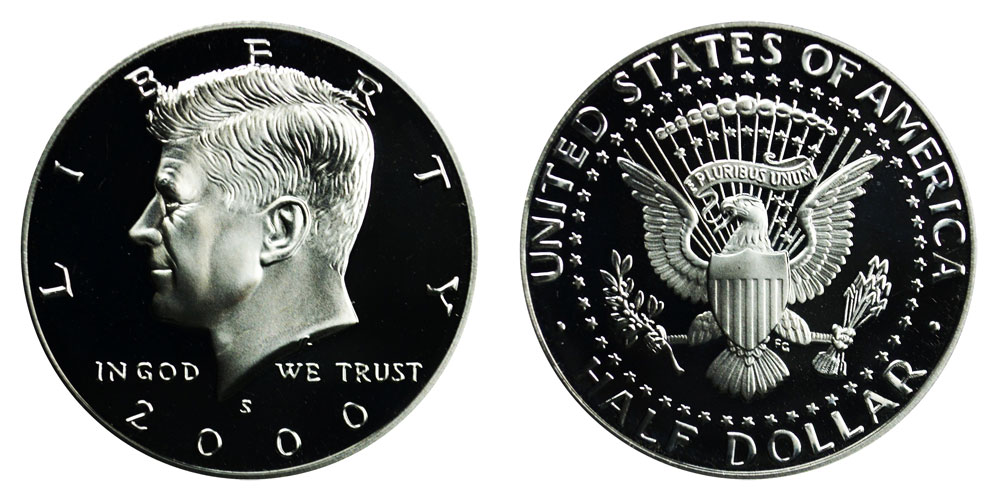
How to Grade Your 2000 Kennedy Half Dollar
Condition is the single biggest driver of value for the 2000 Kennedy half dollar series. Here's what each grade level looks like in practice:
Worn / Circulated (G through VF)
High points of Kennedy's portrait — cheekbones, hair above the ear, and the jaw — show obvious flatness from coin-to-coin friction. The eagle's breast feathers on the reverse merge into flat areas. Luster is gone or nearly gone. Worth face value ($0.50) to about $1 in most cases.
About Uncirculated (AU50–58)
Light wear visible only on the very highest points — the cheekbone and the tip of the eagle's wing. Some original mint luster remains in the protected areas around the design. These coins often look better than circulated examples but still technically show friction. Value: $1–$4.
Uncirculated / Mint State (MS60–MS65)
Full original satiny mint luster present. No wear whatsoever, but contact marks (bag marks) from other coins during shipping and storage may be present. At MS63, scattered marks are acceptable. At MS65, marks are minimal and confined to non-focal areas. Value ranges: $4–$30+ depending on exact grade and mint.
Gem / Superb Gem (MS66–MS68+)
Near-perfect surfaces with blazing, undisturbed luster. At MS66, only minor marks under magnification are acceptable. MS67 is condition-rarity territory for the 2000-D (fewer than 100 known). MS68 on the 2000-P is the condition census. A coin must look flawless to the naked eye and near-flawless under 5× magnification to reach MS67.
🔬 CoinHix lets you photograph your 2000 Kennedy half dollar and compare it against graded reference examples to help match condition tiers before submission to a professional grading service — a coin identifier and value app.
Where to Sell Your Valuable 2000 Half Dollar
The right venue depends on your coin's grade, variety, and how quickly you want to sell. Here's the honest breakdown:
🏛️ Heritage Auctions
The top choice for certified gems (MS67+ / PR70) and dramatic error coins. Heritage's dedicated numismatic audience will recognize condition rarity and bid accordingly. The 2000-D MS67 record of $960 was achieved here in October 2018. Expect 15–20% seller's fees; minimum lot values apply.
🛒 eBay
Excellent for certified mid-grade examples (MS64–MS66) and silver proofs. To research recently sold prices for 2000-D Kennedy halves and similar listings, filter eBay's completed sales to see actual transaction prices rather than asking prices. Certified coins in PCGS or NGC holders consistently outperform raw examples.
🏪 Local Coin Shop
Convenient for quick cash on circulated examples or common-grade uncirculated coins worth $1–$15. Expect offers at 40–60% of market value — dealers need a margin. Bring multiple comparable listings printed from eBay if you want to negotiate. Best for low-value examples where auction fees would eliminate profit.
💬 Reddit (r/Coins4Sale)
Growing marketplace for direct collector-to-collector transactions. Works best for raw but high-quality coins where you can post excellent photos and attract knowledgeable buyers. No formal listing fees, though you'll need established community reputation. Better suited to mid-range coins ($20–$200) than extreme rarities.
Frequently Asked Questions
How much is a 2000 half dollar worth?
Does the 2000 half dollar contain silver?
What makes the 2000-D half dollar special?
What 2000 half dollar errors are worth money?
How do I tell a 2000-P from a 2000-D half dollar?
Is the 2000 half dollar rare?
What is the highest grade recorded for a 2000 half dollar?
Should I get my 2000 half dollar graded by PCGS or NGC?
What year was Kennedy first put on the half dollar?
Where is the best place to sell a valuable 2000 half dollar?
Ready to find out what your coin's worth?
It takes 30 seconds. Pick your mint mark, condition, and errors — and get an instant estimate.
Calculate My 2000 Half Dollar Value →